
UTR Is God
How UTR is changing the landscape of tennis for good and bad


UTR has quietly become one of the most powerful forces in modern tennis. What began as a useful rating tool is, in many ways, now woven into the identity of players, the decisions of parents, the strategies of coaches, and the structure of tournaments. For a lot of juniors and families, UTR is no longer just a number on an app; it is a verdict, a label, almost a kind of god that blesses or punishes, exalts or demotes. The phrase “UTR is God” sounds like sarcasm, but it captures something very real about how deeply this algorithm has embedded itself into the tennis culture.
Part of the reason UTR feels so “godlike” is that it is both omnipresent and treated as omniscient. Wherever you look in competitive tennis now, UTR is there: on tournament pages, in recruiting conversations, in practice courts where kids whisper about each other’s ratings before they’ve even hit a ball. A new player arrives at a training session and the first question is not “Where are you from?” or “What tournaments do you play?” but “What’s your UTR?” That number becomes a shorthand for the player’s worth, their perceived potential, their tennis identity. And because the system is powered by an algorithm—cold, mathematical, seemingly objective—people treat its output like a kind of absolute truth. If the algorithm says you’re a 9.4, then you are a 9.4. If your number dips, something must be “wrong” with you. If it rises, you are suddenly more valuable.
The irony is that UTR is, at its core, just technology. It is code. It is an algorithm cooked up by human beings, refined over time, and applied to a messy, emotional, unpredictable sport. Like many technologies, it has solved some problems and created others. On the positive side, UTR is remarkably accurate in many cases. It provides a powerful metric that helps match players of similar levels. It has made it easier for clubs and private organizers to run flexible events, to schedule competitive matches, and to create local circuits that feel meaningful. It has great usability compared to older systems: the app works well, the interface is friendly, and it fits seamlessly into the smartphone world kids already live in. In some ways, UTR stepped into a vacuum created by slow, rigid, bureaucratic national systems, and simply did tournaments, ratings, and usability better.
But the strengths of UTR are exactly what can make it dangerous, especially for kids. It is always there, always updating, always giving feedback. In the past, a player might check their ranking once a month, or wait for a year-end booklet in the mail to see a printed list. There was built-in delay, a natural cooling-off period between performance and evaluation. Today, a junior can pull out a phone and see, almost in real time, what a result did to their rating. The number is in their pocket, in their face, all the time. For a developing child or teenager, that constant measurement can become an obsession. Checking UTR starts to resemble checking social media likes: a loop of validation and anxiety.
That obsession quickly spills over into how tournaments are chosen and how matches are played. Parents scroll through entry lists, scanning UTRs before they even decide whether to sign up. If the field looks “too weak,” they may pull out, worrying that their child will risk losing UTR points by playing opponents with lower ratings. If the field looks “too strong,” they may also pull out, afraid of bad losses or blowouts that hurt the number. In both cases, the decision to compete is no longer based on development, experience, or the simple value of battling, but on the perceived risk and reward to an algorithm. In the same way, children start to think like stock traders: avoiding “bad investments,” choosing only tournaments and matches that seem safe for their rating profile.
There is also a subtle but serious impact on character development. Competitive tennis used to carry with it a simple, tough, and in many ways healthy ethos: you sign up for tournaments, you show up, and you play whoever is across the net. You don’t always know who will be there. You might face stronger players; you might face weaker ones. If you’re the underdog, you fight. If you’re the favorite, you still fight, or you work on parts of your game that need practice. You stay in the backdraw. You finish the event. That process builds resilience, humility, courage, and an acceptance that sometimes you lose, sometimes you win, but you always compete.
The UTR era has introduced the option—and the temptation—to duck. With entry lists and ratings visible in advance, it is now easy to withdraw if the draw looks too hard, or skip a tournament entirely if it looks too easy. Kids skip backdraws because those matches have “too much risk” for their rating and not enough perceived reward. Parents rationalize pulling out of events at the last minute because “the level is not right” or “this tournament will be a waste of time” for their child’s UTR. That way of thinking may make sense strategically in a narrow, short-term, numbers-based mindset, but it chips away at the values that sport is supposed to instill: grit, responsibility, following through on commitments, and learning from every match, not just the ones that look perfect on paper.
Another consequence of the algorithmic mindset is that players become reluctant to experiment in competition. In the past, a strong player facing a weaker opponent might use that match to work on specific elements: a new serve pattern, a different style of returning, more net play, or a weaker side like the slice backhand. The scoreboard still mattered, but there was room to see certain matches as laboratories for growth. Now, because every game and every set can affect a live rating, players are terrified to “mess around” or take risks. If they try to come to net more often and lose games, the algorithm might punish them. If they deliberately practice a second serve more aggressively and double fault a few times, their precious number could drop. As a result, tournaments become less a place to grow and more a place to protect status, which is the opposite of what junior events should be.
None of this means that UTR is inherently evil. In many ways, the system is a rational response to genuine problems in traditional tennis structures. National federations, such as the USTA, have often been slow, bureaucratic, and insensitive to customer experience. Complicated progression systems, rigid age mandates, clunky websites, late-night scheduling, and poorly handled cheating have driven many families away from federation-run events. In that vacuum, UTR and other independent circuits have offered a fresher, more flexible, and user-friendly alternative. They deserve credit for innovation, ease of use, and for giving organizers tools to run creative events. The problem isn’t that UTR exists; the problem is how the culture around it has evolved and how uncritically many of us accept the algorithm as the ultimate measure.
There is also a bigger landscape to consider. Tennis itself is in competition with other sports and activities. The rise of pickleball, padel, and similar racquet sports highlights failures in how tennis has served certain segments of the population. The explosion of UTR highlights failures in how federations have managed tournaments, rating systems, and technology. Both trends are warning signs: when large numbers of players flock to alternatives, it means traditional structures were not meeting their needs. So in one sense, UTR is a symptom of a broken system as much as it is a cause of new problems.
For parents and coaches, the challenge is not to reject UTR outright, but to put it back in its proper place. The rating can be treated as a useful tool rather than a god. That starts with the language adults use around kids. If every conversation is about UTR points, projected movements, and who is rated higher, the child will naturally fixate on the number. If, instead, the main conversations are about how well they competed, what they learned tactically, how they handled nerves, or what technical improvements they want to bring from practice into matches, then the rating becomes background noise, not the central story.
Scheduling is another area where adults can make a difference. Rather than scanning lists to find “perfect” fields, parents and coaches can commit to a more old-school approach: choose a reasonable calendar of events, sign up, and honor those commitments regardless of who enters. Teach the child that you do not duck strong draws, nor do you flee weak ones. If the draw is tough, talk about the opportunity to test themselves and grow. If the draw is soft, talk about taking care of business, staying professional, or using the chance to work on specific skills under match pressure. This way, tournaments become chapters in a long developmental story, not just occasions to feed an algorithm.
The addiction to the app is harder to tackle because it is part of a broader cultural pattern that includes social media, games, and constant phone use. But even here, boundaries can be set. Parents can limit how often a child is allowed to check their UTR. Coaches can avoid bringing up the rating in every lesson. Together, they can remind players that one match, one week, or even one month does not define their long-term potential. The goal is to shift attention from “What did this do to my number?” to “What did I gain as a player from this experience?”

There is also a responsibility on the part of organizations—UTR itself, national federations, and tournament operators—to recognize the psychological and developmental side effects of a hyper-visible rating culture. They could explore incentives that reward participation and perseverance, not just results. They could experiment with formats that encourage playing out backdraws or trying new things without fear of harsh rating penalties. They could invest in education for parents and coaches about healthy tournament scheduling and mindset. If an algorithm is going to be central to the competitive experience, its designers should consider not only statistical accuracy but human behavior—especially the behavior of children.
In the end, the phrase “UTR is God” is a warning as much as it is a joke. It points to the danger of allowing any single metric to dominate how we see ourselves and our children. Tennis is too rich, too complex, and too human to be reduced to one number on a phone screen. A rating can be helpful, even powerful, but it should never be allowed to define a child’s self-worth, dictate all their competitive decisions, or erase the deeper lessons that sport can teach about courage, humility, effort, and joy. Players, parents, coaches, and organizers all have a role in pushing back against the worship of the algorithm and reclaiming tennis as a place where development and character matter more than any digital verdict.
If we can do that—if we can use UTR without bowing to it—then the rating system can remain what it was meant to be: a tool in service of the game, not a god ruling over it.
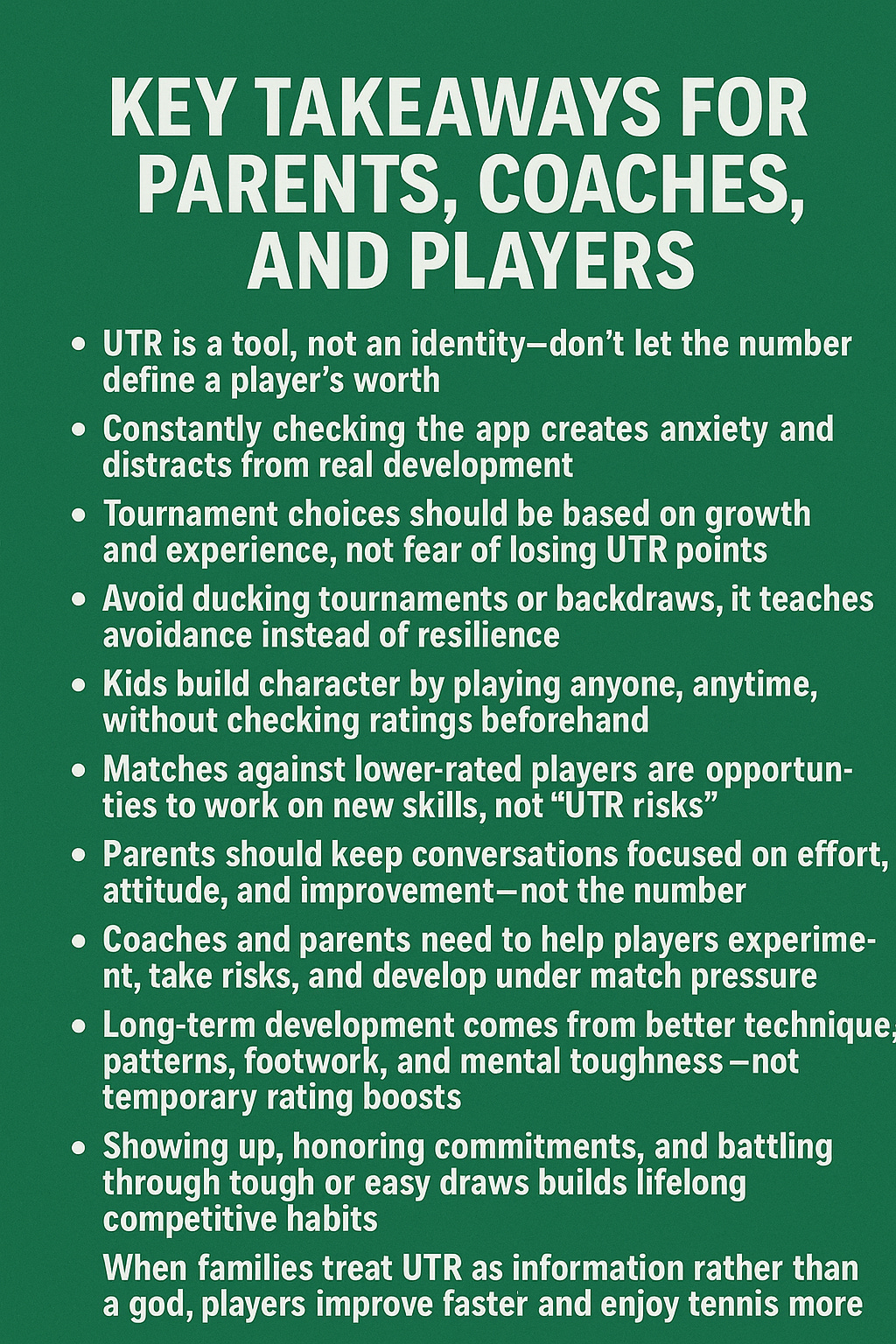
Key takeaways for parents, coaches, and players:
UTR is a tool, not an identity—don’t let the number define a player’s worth.
Constantly checking the app creates anxiety and distracts from real development.
Tournament choices should be based on growth and experience, not fear of losing UTR points.
Avoid ducking tournaments or backdraws; it teaches avoidance instead of resilience.
Kids build character by playing anyone, anytime, without checking ratings beforehand.
Matches against lower-rated players are opportunities to work on new skills, not “UTR risks.”
Parents should keep conversations focused on effort, attitude, and improvement—not the number.
Coaches and parents need to help players experiment, take risks, and develop under match pressure.
Long-term development comes from better technique, patterns, footwork, and mental toughness—not temporary rating boosts.
Showing up, honoring commitments, and battling through tough or easy draws builds lifelong competitive habits.
UTR should guide scheduling—not control it.
When families treat UTR as information rather than a god, players improve faster and enjoy tennis more.
Watch Chris’s podcast on this same topic!
My son was a senior in hs when UTR became popular and it was good for him because he reached his full height and strength quickly and UTR was much more nimble at clocking his improvement than USTA. His ranking rose fast. I also liked that girls could compete at a higher level. There were so many UsTA tournaments where there would be 8 girls in the draw and 32 boys and UTR gave girls more opportunity. But I can absolutely see the concerns you raise. Will be interesting to see how UTR evolves.
Chris - I've been out of the tennis game for long enough not to really see what UTR has done to the sport. Interesting read. Hope you are well!