
The Wrong Question About American College Tennis

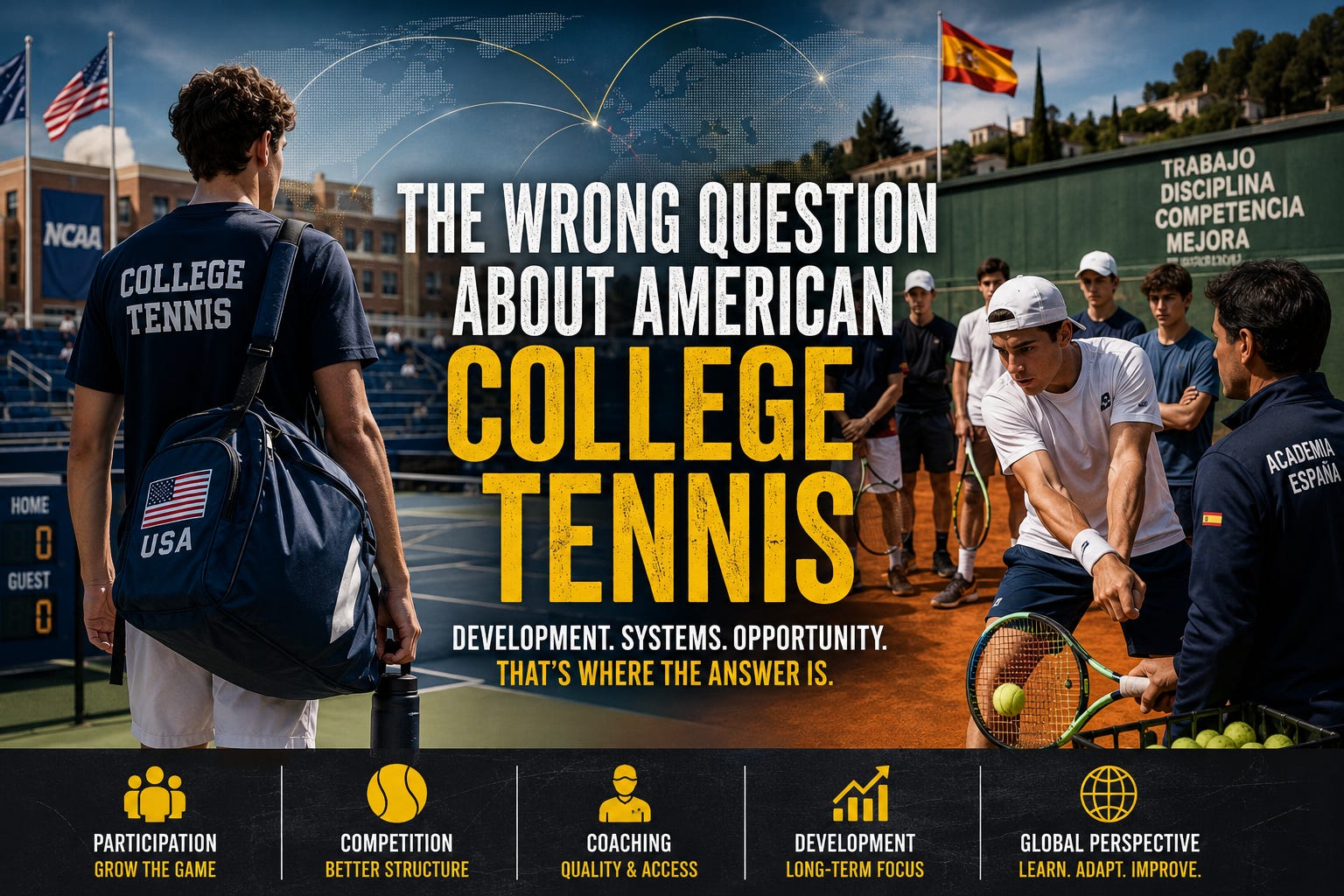
The debate over “where all the Americans are” in college tennis is loud, emotional—and pointed in the wrong direction. When Patrick McEnroe asks why fewer Americans are showing up in top NCAA lineups, he is pointing to a real trend. International players now make up a significant portion of Division I rosters, especially at the highest levels. But the conclusion many people draw from that trend is flawed.
If international players are taking roster spots, the answer is not to protect those spots for Americans. The answer is for American players to get better and earn them. College tennis should be competitive. Coaches are paid to win. They should recruit the best players available—regardless of passport. That is the whole point of competition.
That said, there is one place where the concern is valid: fairness. If there are loopholes that allow older or more professionally seasoned international players to enter college tennis with a built-in advantage, those should be addressed. Eligibility rules should be clear, consistent, and enforced equally. An 18-year-old American freshman should not be competing against a 22-year-old international “freshman” with years of high-level experience under his belt because the rules are being applied unevenly.
Level the playing field. Close the loopholes.
But after that, American players should have to earn their keep. This is where Andy Roddick has taken a more grounded approach on his podcast, Served with Andy Roddick. He acknowledges the same reality—that college tennis is now a global marketplace—but does not frame it as a problem to be solved by limiting international players. Roddick's instinct is right: international competition does not hurt American players; it reveals where the American system has fallen short. The answer is not to protect spots. The answer is to develop players who do not need protection.
And development is where this conversation needs to go. I have spent the last 20 years studying tennis in Europe, especially Spain, and wrote a comprehensive book on Spanish tennis methods, The Secrets of Spanish Tennis. That has given me a fairly unique vantage point on the differences between player development in Europe and the United States. The issue is not that European or international players are magically better. The issue is that many of them come through systems that are more coherent, more competitive, more accessible, and often better designed for long-term development.
The variables are not mysterious. Training systems matter. Access matters. Cost matters. Hard work matters. Participation rates matter. Competition structures matter. The drain of athletic talent into other American sports matters. Coaching quality matters. The number of serious players in the system matters. The density and variety of clubs, coaches, practice partners, tournaments, and playing styles matter. Europe has advantages we cannot perfectly copy, especially the diversity of styles and the healthy mix of cultures, surfaces, and competition that players encounter at a young age. But we can absolutely build a better American competitive pathway than the one we have now. That is the real issue.
The question is not why there are so many international players in U.S. college tennis. The question is why the American system is not consistently producing enough players who can beat them for those spots.
Junior tennis in the United States is expensive, fragmented, and often inaccessible. Families pour enormous resources into coaching, travel, academies, rankings, and tournaments. The system often rewards money and geography as much as talent. Too many players are priced out before they have a real chance. Others burn out. Others are never properly identified. And in much of the country, it is genuinely hard to find an elite developer. There are excellent coaches in the United States, but they are clustered in certain areas. If you are outside those hubs, the pathway becomes much harder.
The USTA competition structure deserves its own essay—and I have covered some of my critiques in more detail elsewhere on this Substack; see also my article on cheating in American tennis here—but the short version is that I believe it is one of the most broken parts of the American development pathway. The structure changes constantly. Travel is expensive. Cheating is rampant enough that it turns off good families. Competitive junior participation is low compared with the popularity of high school tennis. And we have not properly leveraged the national club infrastructure or the built-in popularity of high school tennis to create a more attractive, affordable, and meaningful competitive system. These are the problems I see on the ground hurting kids who are trying to reach the 11, 12, or 13 UTR level needed to compete for college roster spots.
We also have to be honest about who the USTA system is really serving. Many of the truly elite American juniors who are tracking toward the professional tour do not spend their developmental years grinding through the traditional USTA pathway. They often play ITF events, international events, and sometimes spend significant time competing in Europe. So when we talk about college-level American players, we are often talking about the kids below that very top pro-track group—the players who need a strong domestic competition structure to keep improving. That is exactly where the current system often falls short.
Meanwhile, international players often arrive more prepared—technically, physically, tactically, and mentally. Not because they are inherently better, but because many have come through environments that are more efficient, more affordable, more competitive, and more focused on development. In Spain, France, Italy, Argentina, Germany, Serbia, and other tennis cultures, players often grow up in a denser competitive ecosystem. They see more styles. They play more meaningful matches. They train in environments where development is not always tied to endless travel, rankings pressure, and family spending. International players are not the problem. They are exposing the problem.

And here is the part that gets lost in the noise: American tennis at the highest level is not in decline. On the professional tours, the United States is doing remarkably well. Italy dominates the conversation because Sinner sits at the top of the world, but when you count the players rather than the points, the United States has more than double Italy's seven in the ATP top 100, and more than any other nation on earth. As of recent live rankings, the U.S. has 16 men in the ATP top 100 and 14 women in the WTA top 100, which is an extraordinary level of depth across both tours. I discussed this trend in a January article on this very substack. That is not a crisis. That is a success.
In fact, I think the USTA deserves more credit at the professional level than it often receives. The foundation laid during the Patrick McEnroe and José Higueras years helped produce many of the results we are seeing now (see my recent article here on this topic). Player development takes time. You do not always see the impact immediately. But when you look at the current depth of American tennis on both the men’s and women’s tours, it is hard to argue that nothing worked. At the pro level, American tennis is doing more than we could reasonably ask for. So this is not a decline story at the highest echelon. It is a misdiagnosis.
The real concern is not whether America can produce elite professionals. Clearly, it can. The concern is whether the broader American junior system is developing enough players below that top professional tier—players who can become strong college players, late bloomers, high-level Division I contributors, and serious competitors in the 11-to-13 UTR range. That is where the cracks are obvious. That dichotomy—elite success at the top, weakness in the broader developmental layer beneath it—is where the rubber meets the road. This is where access, cost, coaching, competition structure, participation, and retention matter most.
Growing the game is probably the most important lever we have. More players mean more talent and more chances. More talent in the pipeline means better practice and competition clusters. Better competition raises both coaching and playing standards. Participation is not a soft, recreational issue. It is a high-performance issue. If the base of the pyramid is too narrow, the top eventually suffers.
We also need to improve the level and reach of high-performance coaching. Again, there are great coaches in the United States. But there are not enough of them, and they are not evenly distributed. In large parts of the country, a motivated family can find courts, teams, and tournaments, but not the kind of daily developmental environment that turns a good athlete into a high-level D1 college tennis player. That gap matters.
NIL adds another layer to this conversation. College sports have become even more of a business, and college tennis is not immune to that reality. We can bemoan that, and for those of us who want college tennis to remain a healthy developmental and educational environment free from commercial pressures, there is something sad about it. But this is the current reality. If Division I college tennis is becoming more professionalized, then we should not be surprised when coaches recruit globally, international players chase opportunity, and roster decisions look more like marketplace decisions. For players and families who do not want that kind of environment, Division III still offers what I believe is often the college experience framed correctly: academics, team tennis, development, and competition without the same commercial drivers.
We need to be honest about what competition is. If a qualified American player loses a lineup spot to a better international player under fair rules, that is not an injustice. That is the system working. Close the loopholes. Enforce fair eligibility. Make sure everyone is playing by the same rules. And then let the best players play.
American players should not be handed opportunities because of where they were born. They should be developed well enough to earn them. The issue is not whether a foreign player exists on a roster. The issue is whether a player can spend post-high-school years accumulating high-level experience, ATP/WTA/ITF points, or professional-style competition, then enter college as a “freshman” with a meaningful eligibility advantage. If that is happening, close the loophole. If that is not happening, stop blaming international players and focus on why American juniors are not winning those spots.
That is much stronger than saying there are “too many foreigners.”
Excellent analysis.
America shouldn’t fear competition but welcome it
You are punting on the big question. Do American universities exist primarily to educate American youth, including American tennis players, or to have the best tennis teams?