
Rethinking the Net
Why You Shouldn't Rush Forward


Many years ago in Spain, I was on court with Lluís Bruguera, the legendary Spanish coach, and a group of American players I had brought to his academy.
One of them was an eleven-year-old boy, very talented, very eager, and very American in the way he had been taught to think about offense. He got a short ball, moved in automatically, and charged the net. Lluís stopped the practice, walked onto the court, and looked at him.
“Why do you always go to the net?”
The boy shrugged. “To be aggressive.”
Lluís kept going.
“How tall are you?”
The boy shrugged again.
“How wide is your arm span?”
No answer.
Then Lluís pointed to the court. “How wide is the net?”
Now the boy looked confused.
Then came the question that changed the whole lesson. “What is your best shot?”
The boy answered, “Forehand.”
Lluís nodded. “So why do you go to a place that is very wide, when you are not very tall and do not have great reach? Why do you go there to finish the point? Why don’t you use your best shot to attack? Why do you need the net?”
It stopped me cold. The boy looked shocked, and honestly, so was I. I had grown up in New York and in an American tennis culture that treated the net as an unquestioned good. If you got a short ball, you moved in. If you wanted to be aggressive, you attacked the net. That was the instinct. That was the catechism. And here was one of the great Spanish coaches saying something that, in the American coaching world, almost sounded taboo.
The more I thought about it, the more I realized this was not a minor disagreement over tactics. This was a completely different philosophy of what aggression is, when net play makes sense, and how a player should be taught to build a point. The Spanish lesson was not “never go to the net.” It was something more demanding: go only when you have earned the right. That distinction has stayed with me ever since.
The Net Is Not A Moral Good
One reason this moment felt so shocking is that, in American coaching culture, the net is often treated not just as a tactical option but as a kind of virtue. The player who moves forward is seen as brave, assertive, and proactive. The player who stays back is too often described as passive, cautious, or even fearful. But tennis does not reward virtue in the abstract. It rewards sound decisions. A player can move forward and still be making a losing play. A player can stay back and still be the one applying all the pressure in the point.
What the Spanish approach does so well is strip the net of its moral aura. The net is not holy ground. It is not automatically a place of advantage. It is simply another area of the court, and whether moving there is smart depends on context. That is a more mature way of seeing the game that refuses to confuse the appearance of aggression with the reality of control.
Not Every Short Ball Is A Green Light
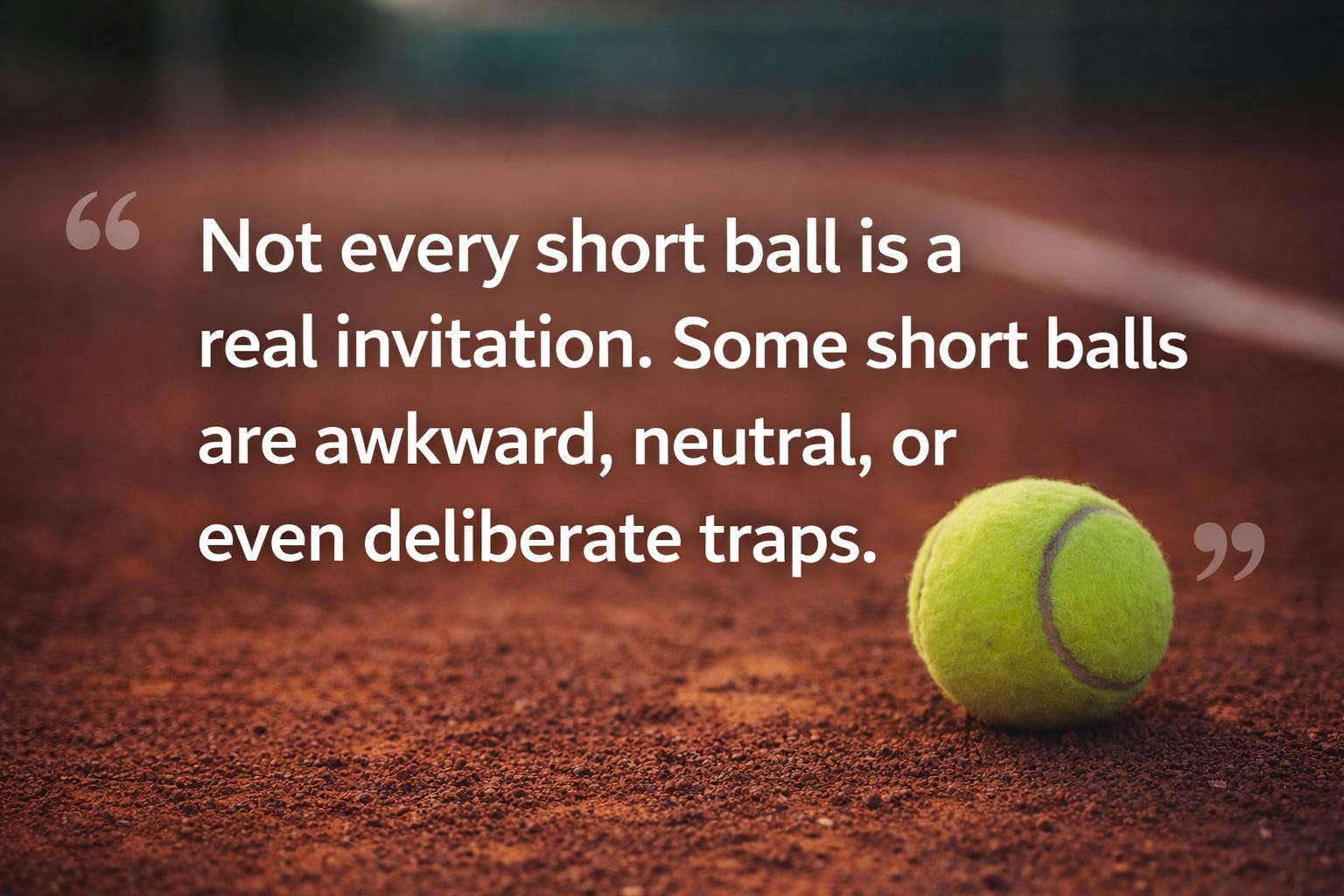
This is where so much American coaching goes wrong. The short ball appears, and the instruction comes instantly: go, attack, move in. But not every short ball is a true opportunity. Some are low and awkward. Some sit in a way that invites a rushed approach without enough penetration on the shot. Some are deliberate traps from good defenders and counterpunchers, who know exactly how eager certain players are to come forward. A player who has been trained to treat every short ball as a command will often walk right into those traps. He sees the court opening up, comes in too soon, and suddenly has to volley from his shoelaces or defend a clean pass or lob.
In those moments, coaches often blame the volley. But the real error usually happened earlier. The approach was chosen automatically instead of intelligently. What the Spanish coach teaches with a phrase like “don’t go to the net” is not hesitation. He is teaching discrimination. He is telling the player that tennis is a reading game, not a reflex game.
You Should Earn Your Way Forward
The Spanish view of net play is not passive at all. In fact, it demands more discipline than the usual American version. Instead of telling the player to rush forward at the first chance, it asks him to build the point properly. Use the serve. Use the return. Use the rally. Move the opponent. Attack the weaker side. Create discomfort. Use your forehand — often your real weapon — to do actual damage before you think about coming in. In this model, the net is not where you go to become aggressive. It is where you go after you have already been aggressive in a productive way.
That difference is enormous. It means the approach shot has to buy you something. It has to force a weaker reply, reduce the opponent’s options, and make the next ball manageable. When players are taught this way, the first volley is easier, positioning is better, and the percentage of successful net approaches increases. The point is not to come in more often. The point is to come in under better conditions.
Sometimes The Smarter Attack Is The Drop Shot
This is the part players almost never think about enough. They assume the only aggressive option is to bring themselves forward. But often the better tactical question is whether you should bring your opponent forward instead. I ask my students this all the time: “Let me get this straight. You go to the net, where your volley is weakest, and your opponent stays on the baseline, where he is strongest? Why don’t you ever flip the tables and bring him to the net, where he is weakest with the volley and overhead, while you stay back, where you are strongest?” That line of questioning usually stops them because it forces them to rethink what aggression actually is. It changes the geometry of the point, but more importantly, it changes the logic.
A good drop shot is not just a soft touch shot or a piece of flair. It can be a way of forcing the opponent out of his comfort zone and into yours. Many players are far less comfortable moving forward, picking up low balls, improvising with touch, and finishing with a volley or overhead than they are grinding from the baseline. Yet players forget this because they are so conditioned to think of the net as a place they themselves are supposed to conquer. Sometimes the strongest play is not to occupy the front of the court but to make your opponent occupy it. That is another form of selective aggression, and often a very intelligent one.
Young Players Need A Base Before A Finish
This matters especially with kids. One of the quiet mistakes in junior development is teaching players to finish points before they know how to construct them. A young player may be talented, fast, and eager, but if he is still small, still developing physically, and still building his identity from the baseline, then constant net rushing is often a tactical fantasy. He simply does not yet have the height, reach, strength, or coverage to make that style pay off consistently. That was the brilliance of Bruguera’s line to the boy in Spain. He was forcing him to confront the physical reality of the court. The net is wide. You are not. Why choose the area of maximum exposure when your best weapon is still your forehand? Why abandon your strength to enter a zone that punishes lack of reach?
This is where the Spanish system often feels more organized and grounded than the American one. It respects the order of development. First, develop the movement, endurance, shot tolerance, patterns, and a weapon from the back of the court. Then, once those things exist, the player can learn how and when to move forward. A player with a solid base can always become more aggressive later. A player who rushes too early often builds major holes into the foundation of the game.
Selectivity Creates Better Odds
In the end, the case for selective net play is not ideological. It is practical. Tennis is a percentage sport, and the best tactical choices are the ones that improve your odds over time. A player who comes in less often but behind stronger approach situations will usually win a much higher percentage of net points than a player who obeys a blanket rule and charges whenever the ball lands short. This is why the Spanish method makes so much sense. It is based on judgment rather than doctrine. The Spanish philosophy holds that surface, opponent, height of contact, score, and court position all matter. It does not reduce the game to slogans like always attack the short ball or an aggressive player always finishes at the net. The Spanish way treats the player as a thinker, not just an executor.
That is why the lesson with Bruguera stayed with me. What sounded at first like heresy turned out to be realism. The net is not always your friend. Sometimes it is a gift. Sometimes it is a trap. Sometimes the aggressive play is to go forward, and sometimes the aggressive play is to stay back one more ball and let your best shot do the work. Once you understand that, the game opens up in a different way. You stop playing by reflex and start playing by reason.
Conclusion
What Bruguera said to that boy in Spain has stayed with me because it exposed something deeper than a tactical disagreement. It revealed how much of American tennis culture still treats forward movement as a virtue in itself. However, the game is more nuanced and demanding than that. Tennis asks players not just to be aggressive, but to be discerning. Not just to attack, but to understand when, why, and under what conditions an attack makes sense.
That is the real lesson behind the taboo phrase “don’t go to the net.” That sentiment is not anti-net, but rather anti-automatic. The player is asked to think before he rushes, to build before he finishes, and to understand that the most intelligent form of aggression is not always the most obvious one. Once you see that clearly, you start to understand the difference between playing hard and playing smart.
Key Insights
In American tennis culture, the net is often treated as inherently positive, almost as a moral good rather than simply a tactical choice.
The Spanish approach is not anti-net; it is anti-automatic. Players are taught to go forward selectively and responsibly.
Not every short ball is a real invitation. Some short balls are awkward, neutral, or even deliberate traps.
A player should earn the right to come forward by building the point first and using a real weapon, usually the forehand, to create damage.
Sometimes the smarter attack is not to take the net yourself but to lure your opponent forward with a drop shot and force him into discomfort.
Young players especially need a strong base from the back of the court before they are taught to finish points aggressively at the net.
Selective net play is not passive. It is a more disciplined way of improving the odds.
The goal is not to attack more often. The goal is to attack under better conditions and make better decisions.
Sign up here to Preorder Chris Lewit’s New Book, Coming August 2026!

Buy the classic book on the Spanish Method, now in its second edition!

As always, a highly persuasive analysis
It’s also good advice for club players (like me) who would do well to think more before rushing to net