
Coaching for All
Why Can Pros Get Coaching, But Kids Compete Alone?

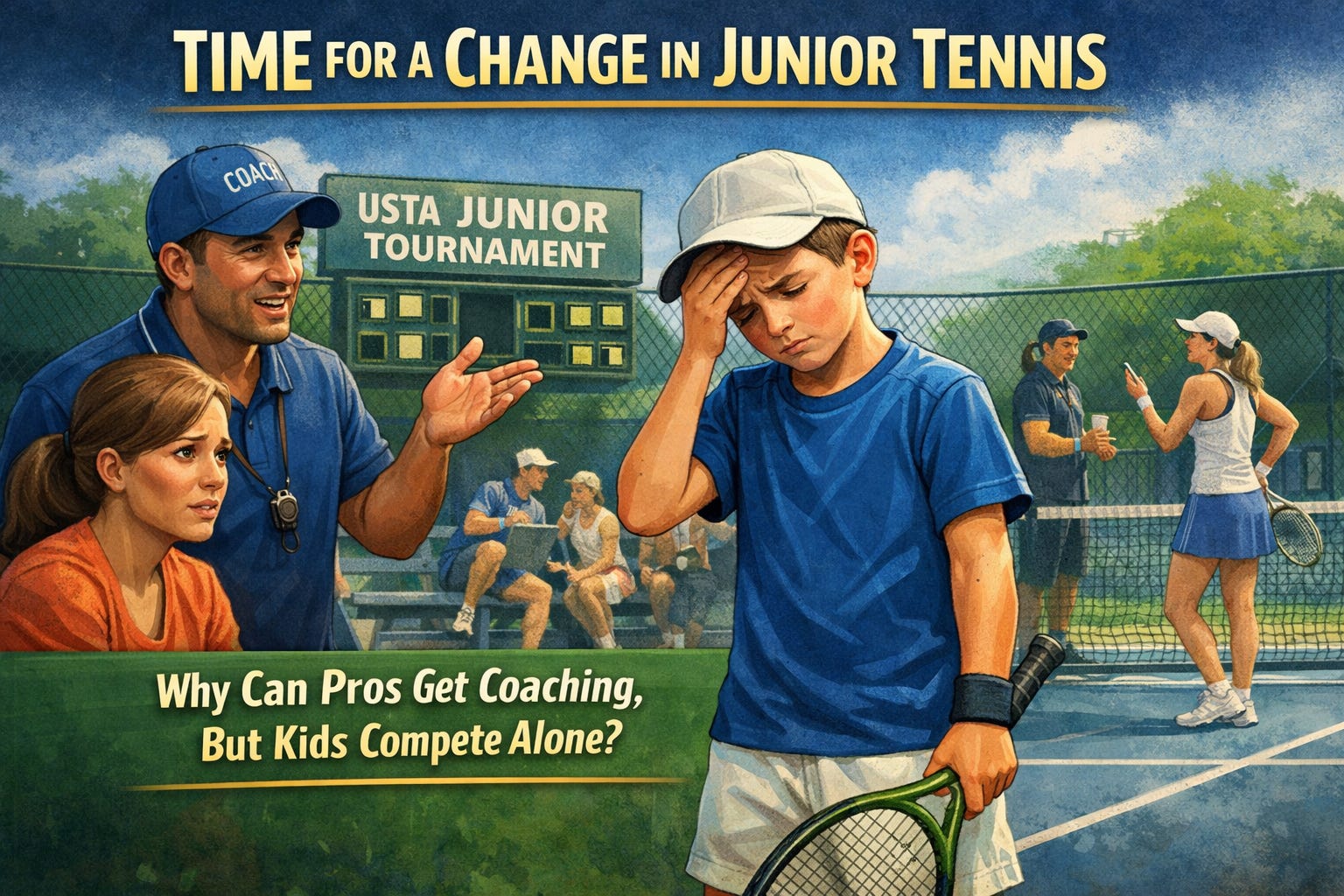
Tennis has changed dramatically over the past several years. The International Tennis Federation (ITF), the ATP Tour, and the WTA Tour now allow coaching in various forms, whether through on-court signals, designated coaching windows, or expanded team involvement. College tennis permits coaching. High school tennis permits coaching. UTR events allow coaching. Yet in many junior tournaments under the United States Tennis Association (USTA), on-court coaching remains restricted or prohibited. That growing incongruity is increasingly difficult to defend. If coaching is acceptable—and even embraced—at the professional, collegiate, and high school levels, why is it withheld from the youngest athletes, who are still developing technically, emotionally, and cognitively?
The Professional Game Has Already Moved On
Professional tennis once prized the idea that players must solve problems entirely alone. That philosophy has evolved as the sport acknowledged something increasingly clear: guidance does not diminish competition—it can elevate it. When the professional tours expanded coaching allowances, critics warned that the sport’s purity would erode. Proponents, however, argued that match quality and strategic depth would improve.
While formal performance studies are limited, governing bodies have continued to expand coaching allowances, suggesting institutional confidence in the model.
In virtually every other competitive sport, coaching during competition is standard practice. In soccer, basketball, football, volleyball, baseball, wrestling, swimming, and martial arts, coaches actively guide athletes during games or matches. Tactical adjustments, emotional regulation cues, and performance corrections occur in real time without any claim that this weakens competitive integrity. Youth sports systems across the world operate on the premise that guided competition enhances development rather than diminishes it. Research in motor learning supports this approach: feedback that is immediate, task-specific, and embedded in performance contexts improves skill acquisition and retention more effectively than delayed or decontextualized instruction (Magill & Anderson, 2014).
Compared with many other sports, tennis has historically placed unusual restrictions on in-competition coaching—especially in some junior formats. If the goal of junior tennis is accelerated development and improved long-term performance outcomes, aligning policy with well-established principles of skill acquisition and the broader practices of competitive sport would be both logical and consistent.
The Developmental Science Case
The developmental argument is even more compelling. Research in child psychology consistently demonstrates that supportive adult involvement enhances emotional regulation and resilience under stress. Morris et al. (2007) show that parental modeling of emotion regulation and emotion-related parenting practices significantly shape children's ability to manage frustration and anxiety. Steinberg and Silk (2002) further find that authoritative parental involvement—combining warmth, structure, and appropriate guidance—is associated with stronger adolescent decision-making and more adaptive responses to stress. Diamond (2013) demonstrates that executive functions — including self-control, working memory, and cognitive flexibility—are trainable through practice, and that stress chronically impairs them, making emotionally overwhelming competitive environments a direct obstacle to their development. Masten (2001) demonstrates that children's resilience under stress is reliably predicted by the presence of supportive adult relationships—not by early exposure to unsupported adversity.
Now consider the reality of junior competition. A 10- or 12-year-old player competes in extreme heat, begins missing shots, grows emotionally overwhelmed, and spirals into frustration. The parent sits a few feet away, unable to speak, unable to guide, unable even to offer calming instruction. The child melts down. The match deteriorates. That is not a meaningful lesson in independence. It is a developmentally misaligned experience. The youngest athletes—those most in need of modeling emotional regulation—are denied support, while mature college athletes and seasoned professionals receive coaching freely. That discrepancy does not align with developmental science or common sense.
Allowing structured, limited coaching at the junior level would not erase independence but teach it more effectively. Coaching conversations can model composure, reinforce process goals, and redirect attention constructively. Children learn emotional regulation not by being abandoned in stressful situations, but by observing calm, structured responses to them. If the objective is long-term resilience, guided exposure is more effective than forced isolation.
Performance Implications for American Tennis
From a performance standpoint, expanding coaching could also benefit American tennis more broadly. When children receive real-time feedback, they learn faster. Tactical awareness improves because adjustments occur during competition rather than days later in practice. Technical habits are corrected before they calcify. Decision-making becomes sharper because feedback is immediate and contextual. Skill development compounds over time. If early learning curves steepen, long-term performance ceilings rise. The same rationale that justified coaching at the professional level applies even more powerfully at the developmental stage.
As this substack has discussed recently, junior tennis also faces a retention challenge. Many children leave the sport because competitive experiences become emotionally overwhelming or discouraging. Structured support could reduce attrition and create more positive tournament environments. Safety and welfare considerations further strengthen the case. Heat stress and emotional overload are real concerns in youth sport. Brief consultation periods or reset timeouts could enhance player well-being without compromising competitive integrity.
Addressing Common Counterarguments
One frequent objection is that coaching would weaken players’ resolve. Yet experience at the college and professional levels suggests otherwise. Coaching has not diluted competitive toughness. Players still execute under pressure. They still adapt. They still solve problems. Coaches provide information and perspective; they do not swing the racket. Structured guidance can actually strengthen resolve by reinforcing strategic thinking and emotional control.
Another concern is that coaching compromises the integrity of tennis. However, integrity has not eroded at the ITF, ATP, WTA, high school, or collegiate levels where coaching is permitted. Clear boundaries preserve fairness. Rules governing timing, language, and conduct can ensure that coaching enhances development without disrupting play.
Parental behavior is also often cited as a risk. Some fear that parents will overstep or behave inappropriately. That concern is legitimate but manageable. This is a regulatory issue, not a philosophical one. Youth sports around the world successfully implement codes of conduct, communication limits, and enforcement mechanisms. Tennis can do the same. Coaching could be limited to changeovers. Communication during live points could remain prohibited. Strict standards regarding language and demeanor could be enforced. Violations could carry meaningful penalties. Structure addresses most abuse concerns.
Equity arguments can also be resolved through thoughtful design. Tournaments could provide roving neutral coaches available to all players. Designated coaching windows could apply equally across matches. Optional tournament-provided coaching services could be offered, similar to how tournaments provide trainers. Certified parent coaching could be permitted under standardized guidelines. Expanded allowances could initially focus on younger divisions, where developmental needs are greatest. Fairness requires intelligent implementation, not prohibition.
A Better Future for Junior Competition
Coaching reform at the junior level could dramatically improve the competitive experience for families. Parents would no longer feel helpless as their child struggles emotionally. Children would receive calm, constructive guidance at moments when it matters most. Learning trajectories would improve because feedback would be timely and contextual. Match quality would rise as tactical awareness deepens. Retention could increase as competitive tennis becomes less isolating and more supportive and educational.
The modern game has already evolved to recognize that coaching and competition are not opposites. They are complementary. If the mission of junior tennis is development, then policy should reflect both developmental science and the realities of modern sport. Coaching for all—implemented thoughtfully, structured carefully, and governed responsibly—could transform junior competition into a more aligned, humane, and effective pathway for young athletes.
Key Insights and Practical Implementation Ideas
• USTA rules on junior coaching are currently out of step with the modern game. Coaching is permitted at the professional, collegiate, high school, and UTR levels, making its prohibition in junior competition increasingly incongruous.
• Developmental science supports structured adult guidance. Younger athletes benefit from modeled emotional regulation, real-time feedback, and supportive scaffolding during stress.
• Coaching does not weaken competitive resolve. Evidence from college and professional tennis shows that players remain resilient and independent even with coaching access.
• Early feedback accelerates learning curves. Timely corrections during matches improve tactical awareness, technical habits, and long-term performance ceilings.
• Retention and well-being improve when emotional overwhelm is addressed constructively rather than ignored.
• Fairness concerns are solvable through structure, not prohibition.
Implementation Pathways
• Allow coaching only at changeovers and set breaks.
• Prohibit communication during live points.
• Limit consultations to brief, clearly defined windows (e.g., 60–90 seconds).
• Require signed parent and coach codes of conduct.
• Enforce strict penalties for abusive language or disruptive behavior.
• Provide optional neutral roving coaches available to all players.
• Pilot expanded coaching rules in younger age divisions (10U–14U).
• Introduce structured emotional reset or heat timeouts for junior players.
• Offer parent education modules on constructive match communication.
• Collect performance and retention data from pilot programs to guide policy refinement.
References
Diamond, A. (2013). Executive functions. Annual Review of Psychology, 64, 135–168.
Magill, R. A., & Anderson, D. I. (2014). Motor learning and control: Concepts and applications (10th ed.). McGraw-Hill.
Masten, A. S. (2001). Ordinary magic: Resilience processes in development. American Psychologist, 56(3), 227–238.
Morris, A. S., et al. (2007). The role of the family context in emotion regulation development. Social Development, 16(2), 361–388.
Steinberg, L., & Silk, J. S. (2002). Parenting adolescents. In M. H. Bornstein (Ed.), Handbook of Parenting, Vol. 1 (2nd ed.). Lawrence Erlbaum.


Comprehensive and convincing
And well written